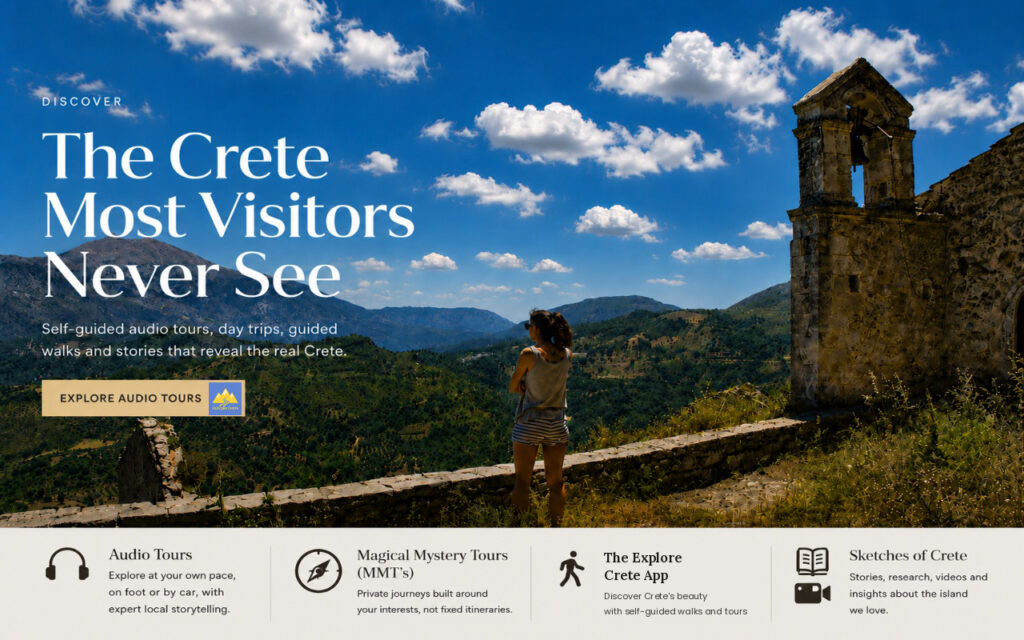
Magical Crete helps you discover the Crete that lies beyond beaches, guidebooks and coach tours. Explore at your own pace with self-guided audio tours, follow carefully researched driving routes through the island’s hidden corners, join us on bespoke guided walks, or delve deeper into Crete’s history, archaeology and traditions through our growing collection of articles and research.
Created by Magical Crete and narrated in up to twelve languages, these audio tours combine local knowledge, historical research and storytelling to help you explore Crete at your own pace.
Choose from three different types of audio tour:
Walking and Hiking
Explore the beauty of Crete’s wonderful nature on foot.
WalkAbout
Explore towns, villages and landscapes, revealing the stories, history and hidden details that most visitors miss.
Day Trips by Car
Follow carefully designed driving routes that connect villages, landscapes, monasteries and historical sites across the island.
Not everyone wants to follow a guidebook, sit on a crowded coach, or rush from one attraction to the next.
Our private day trips are designed around your interests. History, archaeology, mythology, nature, photography, wild flowers, traditional villages or simply discovering parts of Crete that most visitors never see.
Every itinerary is created individually. We never mix clients into larger groups, and we are equally happy to organise a day for one person as we are for a family or small group.
Whether you want to explore the hidden valleys of Amari, the remote monasteries of Mylopotamos, forgotten mountain villages, or some combination of all three, we create the day around what interests you most.
The Explore Crete App is designed for independent explorers who enjoy discovering places beyond the usual tourist routes.
Whether you are interested in history, archaeology, nature, wild flowers, traditional villages or simply spending a day outdoors, the app helps you find routes that reveal a different side of Crete.
Each walk or tour includes maps, photographs, route guidance and background information to help you understand not just where you are going, but why a place matters.
New walks and tours are added regularly, allowing you to build your own collection of routes and explore the island at your own pace.
Sketches of Crete brings together our articles, videos, field research and historical investigations into the people, places and stories that make Crete unique.
Some Sketches explore forgotten monasteries, abandoned villages and ancient sites. Others examine local traditions, mythology, archaeology, wild flowers, historical records or the lives of people who helped shape the island.
Rather than simply describing what can be seen, Sketches of Crete asks why places matter, how they connect to one another, and what they can tell us about the island’s past and present.
New articles and videos are added regularly as our research continues, offering a deeper look at the Crete that exists beyond the guidebooks.
We use cookies to improve your experience on our site. By using our site, you consent to cookies.
Manage your cookie preferences below:
Essential cookies enable basic functions and are necessary for the proper function of the website.
These cookies are needed for adding comments on this website.
Statistics cookies collect information anonymously. This information helps us understand how visitors use our website.
SourceBuster is used by WooCommerce for order attribution based on user source.